
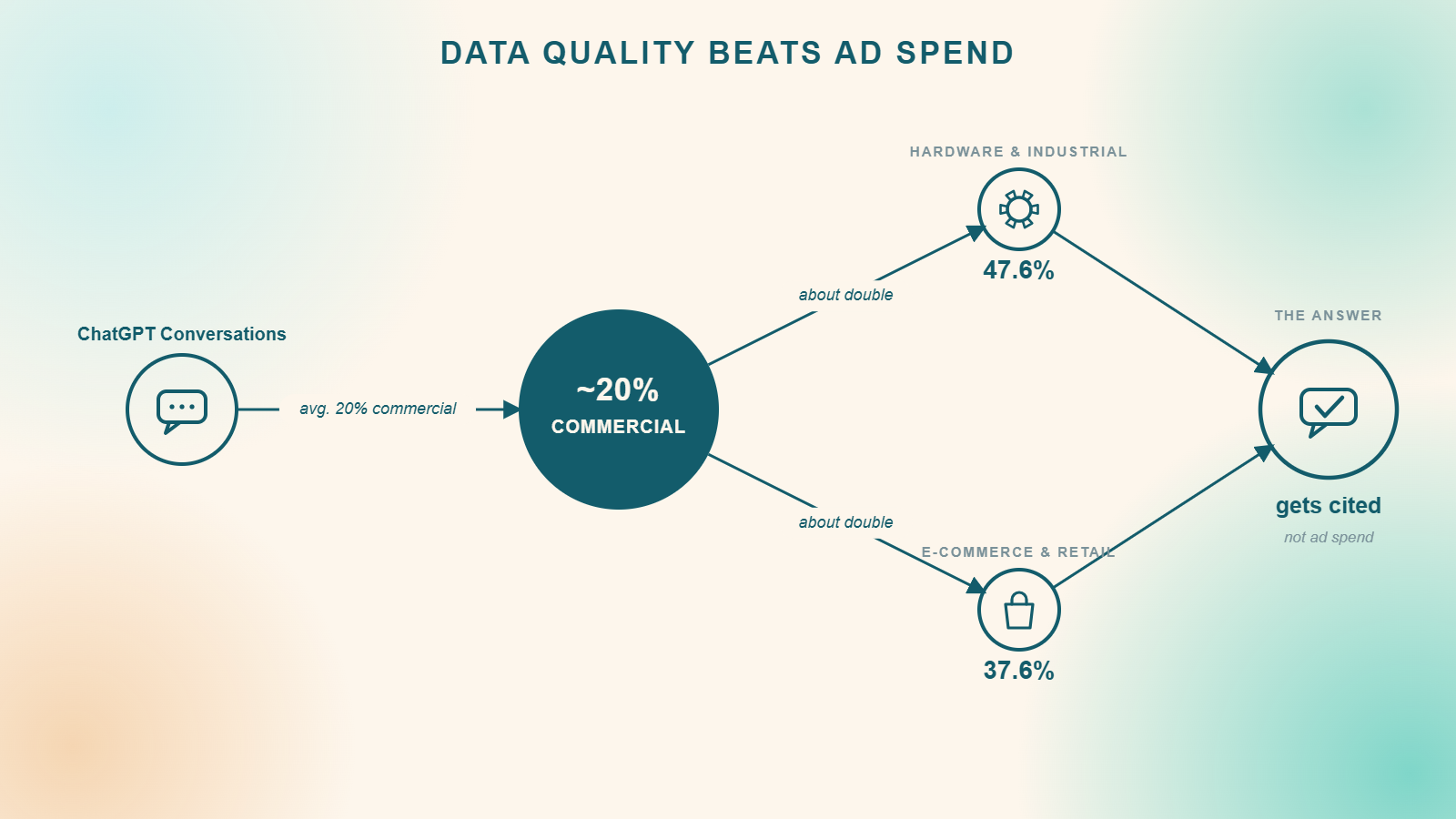
OpenAI's own ads lead put it at Cannes Lions: about 20% of ChatGPT queries are commercial. For manufacturers and retailers, the share is roughly double that – and from here on, what gets you recommended isn't ad spend, it's the quality of your product data.
"People don't come to ChatGPT to browse – they come super intentional, with a job to be done." – David Dugan, OpenAI, VP/Head of Global Ads Solutions, Cannes Lions 2026
When OpenAI's ads lead David Dugan took the stage at Cannes Lions in June 2026, he said a sentence that should echo through every marketing department: roughly 20% of all ChatGPT queries carry direct commercial intent (Marketing Dive, June 2026; also Ad Age). With roughly 900 million weekly active users – the official figure OpenAI reported in February 2026 – this is not a niche phenomenon. It's a channel on the scale of the largest search or marketplace traffic most manufacturers and retailers have today.
Here's the catch: unlike Google Ads or a marketplace placement, you can't buy your way into this channel. OpenAI did launch ads inside ChatGPT in early 2026, now live in seven markets – but that buys you a slot next to the answer, not a place inside the answer itself. The line "you can't buy your way into ChatGPT answers," currently making the rounds on LinkedIn, is half right and half outdated: ads exist now, but the organic answer – the one that actually counts as a recommendation – is still based purely on what the model can find, understand, and trust as a source.
20% is a catchy number – but it's also a snapshot of a fast-moving figure, and depending on who's measuring and what counts as "commercial," the numbers diverge sharply. Worth unpacking properly instead of repeating the headline figure uncritically.
Profound, an AEO-visibility platform, published the largest study of its kind to date in August 2026: 7.5 million English-language US ChatGPT conversations, LLM-classified over June 2025 to June 2026. Result: the commercial share rose from 13.9% to 19.2% – a 38% relative increase in twelve months. Extrapolated, that's a rise in estimated weekly commercial conversations from roughly 243 million to 533 million, with a sensitivity range of 490–570 million depending on modeling assumptions (Profound, August 2026). Worth flagging plainly: Profound sells AEO-visibility software itself – useful data, but not a neutral source; it comes from a vendor with an obvious interest in this topic being taken seriously.
A more independent read comes from Measure Protocol, a market-research firm with no AEO business model of its own: a permissioned panel of 3,458 US ChatGPT users produced 142,965 real sessions across the first half of 2025. Result: 21.6% of interactions show some commercial intent, 7.1% show strong purchase signals – and product comparisons, at 28%, rank among the single highest-intent categories measured (Measure Protocol, October 2025).
And then there's OpenAI's own NBER working paper, "How People Use ChatGPT" (September 2025), which classifies only about 2% of messages as being about a purchasable product (NBER Working Paper w34255). At first glance, that seems to contradict everything above. It doesn't – it just answers a narrower question. OpenAI's own paper counts tightly: "shopping for a specific product." Profound and Measure Protocol count broadly: researching, comparing, evaluating vendors, including travel, finance, and B2B categories. Both readings are correct; they're just answering different questions. And under either definition, the trend points the same direction: commercial use of ChatGPT is large, and growing fast.
The ~20% average masks how unevenly commercial intent is distributed across industries. Profound's industry breakdown shows Automotive at 59.1%, Travel at 56.1%, Telecom at 47.9% – and for ainavio's core audience, Hardware & Industrial at 47.6% and E-commerce & Retail at 37.6%. For comparison, B2B Software sits at 21.8%, Education at just 6.2%.
In other words: if you're a manufacturer, wholesaler, or industrial supplier, the share of commercial ChatGPT conversations in your category runs roughly double the cross-industry average. For you, AI visibility isn't a brand nice-to-have you'll get to eventually — it's already a bottom-of-funnel channel shaping purchase decisions today, whether you're measuring it or not.
The pattern behind these numbers is remarkably consistent. The commercial queries landing on manufacturer and retailer categories rarely sound like a Google search for a brand name. They sound like: "Which fastener works for aluminum profiles under high vibration load?", "Compare supplier A and supplier B on lead time and certifications", "Which distributor stocks IP67-rated, CE-marked parts?"
These aren't questions a landing page or a good brand story answers. They're questions that can only be answered from structured product attributes: specs, compatibility data, availability, certifications, multilingual content. A language model doesn't quote whatever sounds best – it quotes whatever it can reliably extract as fact. We covered exactly this mechanism in "If AI Search Doesn't Understand Your Product, It Won't Recommend It": garbage in, garbage out applies to AI recommendations just as much as to any other model.
The real difference from classic SEO: a language model doesn't just compare your product data against your competitors' – it compares it against itself, across every channel. If your own shop states different specs than your marketplace listing, different dimensions than your product data sheet, and a different description than your Google Shopping feed, that's an annoyance to a human. To a model scoring trustworthiness as a source, it's a disqualifier. Contradictory data is the single most common reason an AI declines to cite a brand – not lack of awareness.
Becoming the "most quotable source" in your category comes down to five concrete levers:
And a sixth point that's easy to overlook: actually measuring your AI visibility. If you're not regularly checking whether and how ChatGPT, Perplexity, or Gemini cite your catalog, you're flying blind on exactly the channel the numbers above say is growing fastest.
This is exactly where the real work of an agentic PIM happens – not as a buzzword, but as a concrete division of labor across several specialized AI agents working on the same central product record. The Enrichment Agent fills in missing attributes and writes answer-ready, comparison-friendly product copy, instead of an editor patching each product by hand one at a time. The Quality Agent continuously checks for exactly the cross-channel contradictions a language model reads as a trust violation – before they go live, not after. The Translation Agent keeps multilingual content consistent with the source record, instead of every translation becoming its own slowly-decaying data silo. And the Marketplace Agent handles the channel-by-channel adaptation that makes a feed usable on new AI shopping surfaces in the first place.
None of this replaces a dedicated AEO or GEO strategy – that takes more than clean product data. But without this foundation, any AEO strategy is a text with no substructure underneath it. We described the same shift when Google pulled back its organic product carousels: visibility measurably moves to wherever product data is cleanest – and once AI agents actually start shopping on customers' behalf, as we discussed in "Zero-Click Commerce", that exact same data foundation decides who even makes the shortlist.
Getting there isn't something you can greenlight next week with an ad budget. It takes months before a model consistently treats a brand as a reliable source in a product category – the underlying data has to stay consistent, complete, and current for a sustained stretch of time before that trust builds. Start now, and you're the cited source within a quarter. Wait, and you're competing against a head start someone else already built into the model's trust.
In short: Roughly one in five ChatGPT conversations is commercial today – closer to one in two in manufacturing and retail categories. You can buy an ad slot next to the answer; you can't buy the place inside it. What decides that is purely the quality, consistency, and completeness of your product data across every channel. You can't retrofit that in a week – but you can start building it this quarter, instead of regretting next year that you didn't.

Björn Thomsen is Head of Marketing at ainavio, specializing in B2B SaaS, demand generation, marketing automation, and leveraging AI to scale modern marketing processes.
https://www.linkedin.com/in/bjoern-thomsen/
contact@ainavio.com
+49 (0) 2842 - 929987-3
