

How Farfalla centralized its product data and thus simplified digital processes in the long term.

Farfalla Is one of Europe's leading brands for natural cosmetics and aromatherapy. Since 1982, the Swiss family-owned company has been developing high-quality essential oils and natural care products that are produced in Switzerland and distributed internationally. In addition to its own stores in Zurich, Aarau, and St. Gallen, Farfalla is active in specialist retail, via several B2B and B2C online shops on Shopify, and in export, including in Germany, Austria, Japan, and Southeast Asia.

Industry: Natural cosmetics, essential oils, aromatherapy

Company size: Medium-sized family business (approx. 40-100 employees)

Distribution channels: Own branches in Zurich, Aarau, and St. Gallen, several B2B and B2C online shops on Shopify, 700+ care facilities and hospitals

Markets: Switzerland, Germany, Austria, Japan, Southeast Asia

Project partners: Cosmo Consult (ERP integration, Business Central)
With the increasing number of Shopify stores, the different requirements of B2B and B2C customers, and internationalization, the effort required for product data, documentation, and product safety increased significantly. At the same time, customer-specific product lists, for example for different prices, product ranges, or individual offers, became increasingly time-consuming, and existing processes were increasingly reaching their limits. This development made it necessary to conduct a detailed analysis of the existing situation in order to clearly identify the key problem areas.

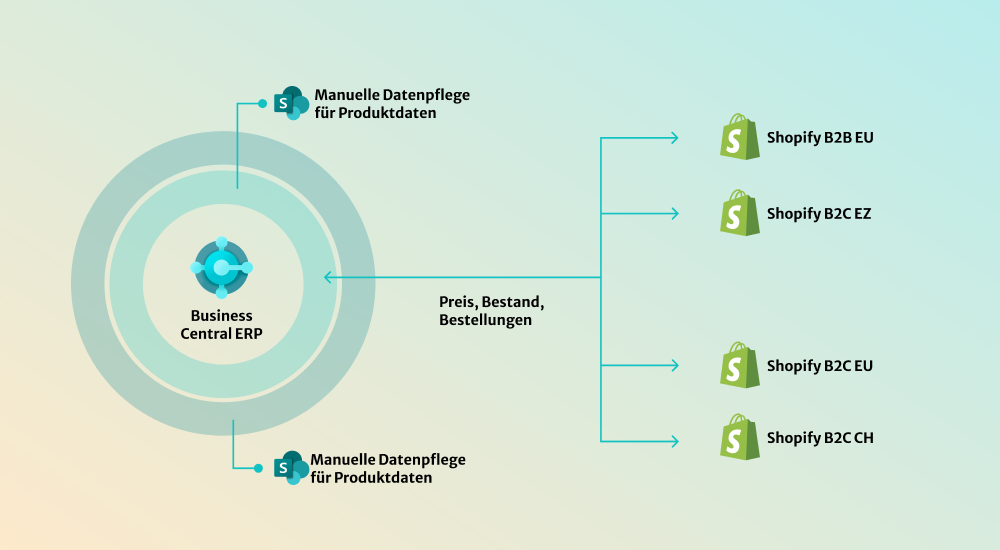
High maintenance due to multiple systems and channels
Product data had to be maintained in parallel for several Shopify stores in the B2B and B2C environments as well as for different countries, while data exchange with Business Central, customer-specific Excel exports, and missing requirements for expansion to other marketplaces such as Amazon further increased the workload.
High manual effort required for changes
Changes to product information had to be made separately in multiple systems. Updating several products at the same time, for example with regard to ingredients or mandatory information, meant additional manual effort and often led to delays.
Decentralized Management of Security Data and Certificates
Important documents such as safety data sheets, certificates of analysis, and warnings were scattered across various storage locations. This made it impossible to maintain them centrally or make them available automatically in the shops.
No centralized management of media and content
Images and other media were stored in different systems and had to be maintained manually. Blog articles could not be reliably linked to the appropriate products, which led to inconsistencies and significantly slowed down the content process.
Together, Farfalla, Cosmo Consult, and ainavio defined three key objectives for future product data management:
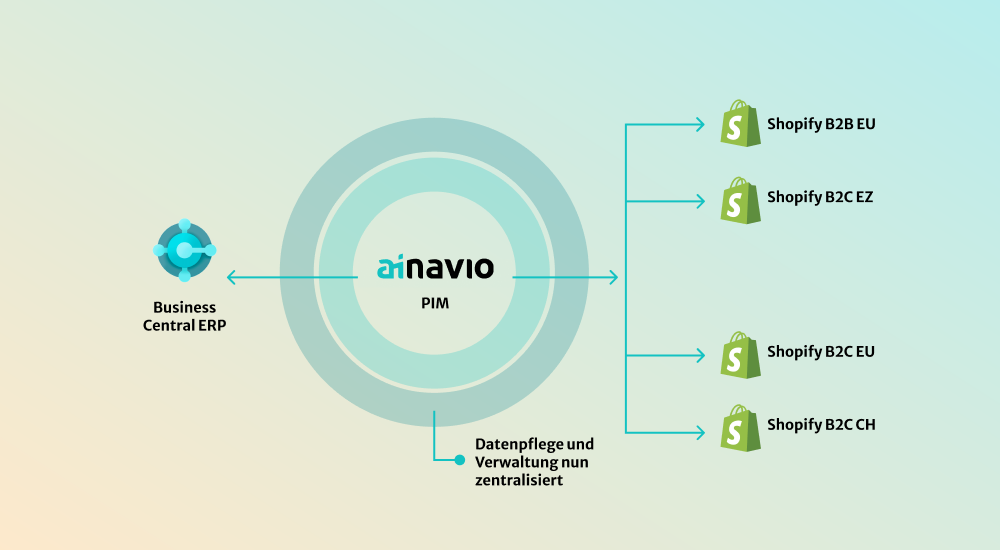
1. Centralized management of all product-related information and documents
Certificates, Analysis Data, Safety Instructions, and Images should be maintained centrally and automatically transferred to all channels from there.
2. Significant reduction in manual work across all systems
Care processes should become faster and more efficient, for example by enabling multiple products to be processed simultaneously and avoiding redundant entries in multiple systems.
3. Seamless integration of all relevant systems and channels
Business Central, Shopify Stores, and Customer-Specific Data Exports should be automatically supplied with product data without any intermediate steps. At the same time, media and content, such as blog articles, should be intelligently linked to products.

Time savings in day-to-day business: Fewer duplicate entries and fewer manually created product lists result in significantly faster handling of product data.
Increased productivity: Changes to many products can be made centrally, regardless of the number of connected channels.
Cost reduction: Automatically generated data exports replace time-consuming manual compilations and reduce internal costs.
High data quality: Centralized data storage ensures that uniform and consistent product information is available in all systems.
Central data source (single source of truth): All product information, documents, and images are managed centrally, so that changes are immediately available in all connected systems.
Consistent data across all channels: Consistent product data is automatically available for B2B, B2C, and international shops without any additional maintenance effort.
Optimized content processes: Blog articles and product information can be neatly linked, which makes marketing and storytelling much easier.
Ready for future growth: Additional markets, shops, or marketplaces such as Amazon can be easily connected at any time.
Team satisfaction: Less repetitive data maintenance creates more space for strategic product data optimization and content development.
The Introduction of Ainavio PIM has fundamentally modernized product data processes at Farfalla. Thanks to the central database, automated workflows, and close integration with Shopify and Business Central, Farfalla can now respond faster, work more efficiently, and scale more easily. The collaboration with Cosmo Consult ensures a robust and future-proof system architecture, from ERP to all digital sales channels.
