Published on November 17, 2026
In AI Mode, Google no longer looks for product features. It looks for answers. Six new Merchant Center fields let European retailers supply what shoppers actually ask today.
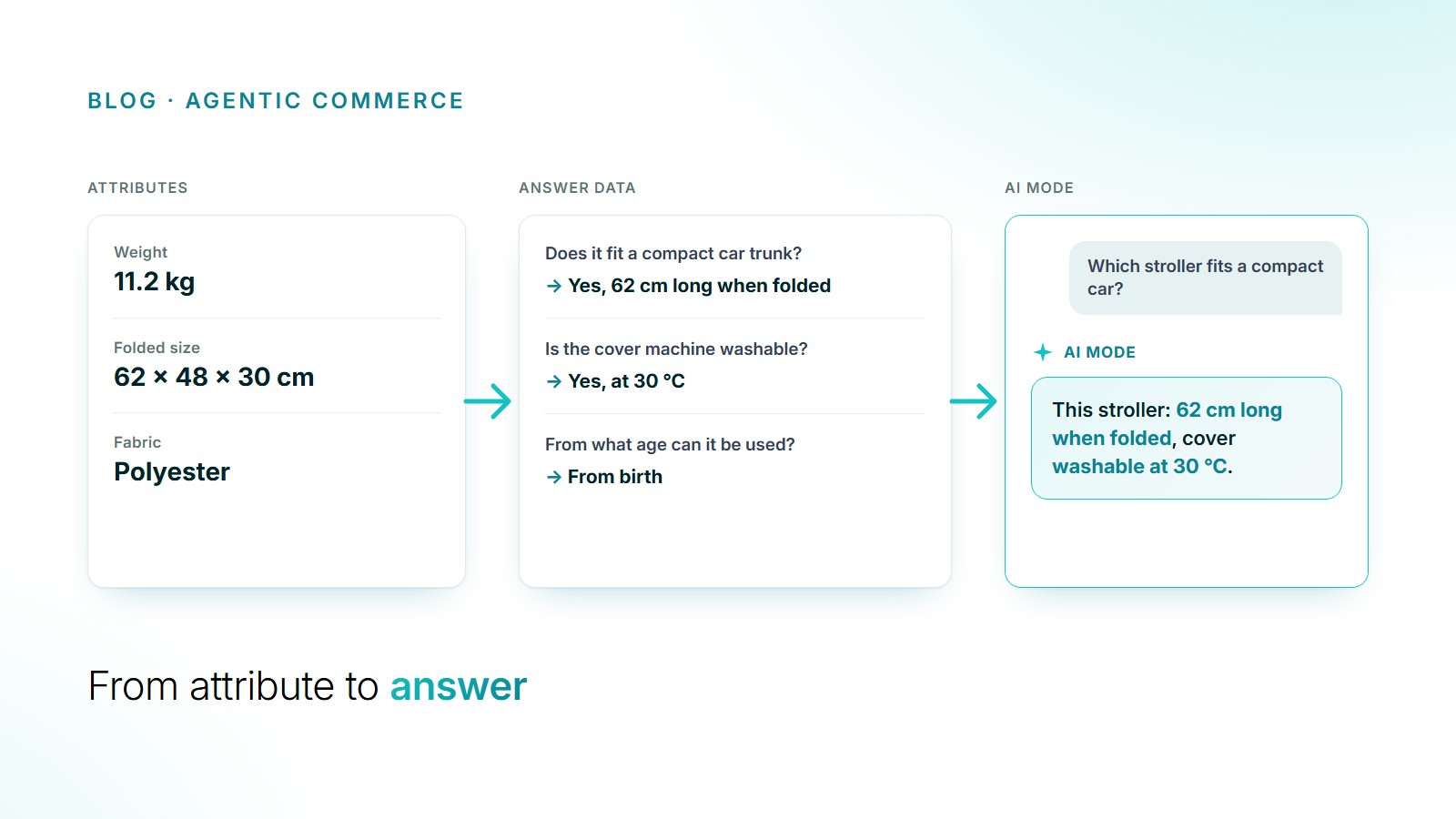
“There is no such thing as a stupid question,” says the good sales assistant. They know the answers before the customer asks: whether the stroller fits in the trunk, whether it folds with one hand, whether the cover can go in the washing machine.
Online shops never had that sales assistant. They had attributes: weight 11.2 kg, folded size 62 × 48 × 30 cm, cover made of polyester. Turning those features into an answer was left to the customer.
Google is now taking over that job. AI Mode has been available in German since October 2025. Someone looking for a stroller there does not type a search query. They ask a question, and Google looks for an answer.
For retailers and manufacturers, it is therefore no longer enough for products to be found. What counts is whether their product data can answer questions.
In mid-September, Google presented a set of agentic commerce updates for the holiday season. Most of it is still a future scenario for the European market:
One week later came the next step. Shopify merchants in the U.S. are getting direct checkout in AI Mode and the Gemini app, and it is switched on by default. Merchants who do not want it have to turn it off themselves.
So is Europe left on the sidelines? Not quite. One part of the announcement already applies everywhere, and it is the most important one.
Google has added six so-called conversational attributes to Merchant Center: question and answer, document link, related product, item group title, variant option and popularity rank. The fields are optional and do not affect the approval status of existing products. According to Google, the question and answer field can be used in all countries.
It looks minor, but it is a break with the past. Until now, product data described what a product is. These fields describe what shoppers want to know about a product. We call this answer data: product information phrased as the answer to a specific buying question rather than as a feature.
Google draws a clear line here. Anything already in the description, product highlights or product details should not be repeated. Keyword lists, prices and dates do not belong there either. What is wanted is exactly what no feed has contained so far.
Try it with a product from your own range, for example the stroller from above. Your PIM probably holds 40 well-maintained attributes for it. Now picture the five questions parents actually ask in a store:
In most product ranges, the data answers one of these questions directly at best. The rest is scattered across user manuals, training documents, service tickets and reviews. Or it lives in the head of the one colleague who has known the range for twelve years.
An AI assistant can only answer these questions if the answers are written down somewhere. If it finds nothing, it recommends a different product it does find information about.
Google cites two figures. Merchants who adopt the core Merchant Center feed best practices see an average 5% increase in conversions the following month. In testing with lululemon, the brand's conversational attributes were incorporated in half of the relevant product recommendations in AI Mode.
Both figures come from Google itself and from the U.S., so they should not be overstated. The direction is still clear: what a brand supplies as an answer ends up in the recommendation. What it does not supply, Google fills in from other sources or leaves out.
The order of the announcements shows where things are heading: first visibility, then advice, then the purchase without a detour through the shop. In the U.S., shoppers can already buy from selected merchants directly in AI Mode. According to Google, UCP already enables direct checkout for hundreds of thousands of brands and retailers.
Google has not said when checkout and Business Agent will come to Europe. Only one thing is certain: when they do, the agent will decide based on the data it finds at that point. Answer data for a range of 20,000 items is not created in the week before launch.
The fields and AI Mode in German are already available today. Those who start now can test under real conditions while competitors are still waiting for checkout.
Answer data is product data. It therefore belongs where all other product data is maintained, checked and published to channels: in the PIM. In a side spreadsheet kept by the marketing team, it will be out of date after the third range change.
In ainavio, question-and-answer pairs can be set up as dedicated, multilingual attributes. The AI Agents handle the time-consuming part:
This turns scattered knowledge into maintained product data that can be published to every channel, including the Google feed.
The good sales assistant kept the answers in their head. In AI Mode, Google takes over that role. But Google does not have years of experience with your range. It only has your data.
There is no such thing as a stupid question. But there are products without answers, and nobody recommends them.
Talk to us about your range, your channels and your legacy systems. We will show you where PIM with AI fits into your setup.
With AI Mode, the search query becomes a question. Through conversational attributes in Merchant Center, retailers and manufacturers in Europe can supply answer data today, long before checkout and Business Agent arrive here. Those who add answers to their product data now will have a head start once agents complete purchases in Europe as well.

Björn Thomsen is Head of Marketing at ainavio, the PIM with AI. His topic is how e-commerce product data works for both people and machines, from the online shop to AI search.
contact@ainavio.com
+49 (0) 2842 - 929987-3

