Published on November 2, 2026
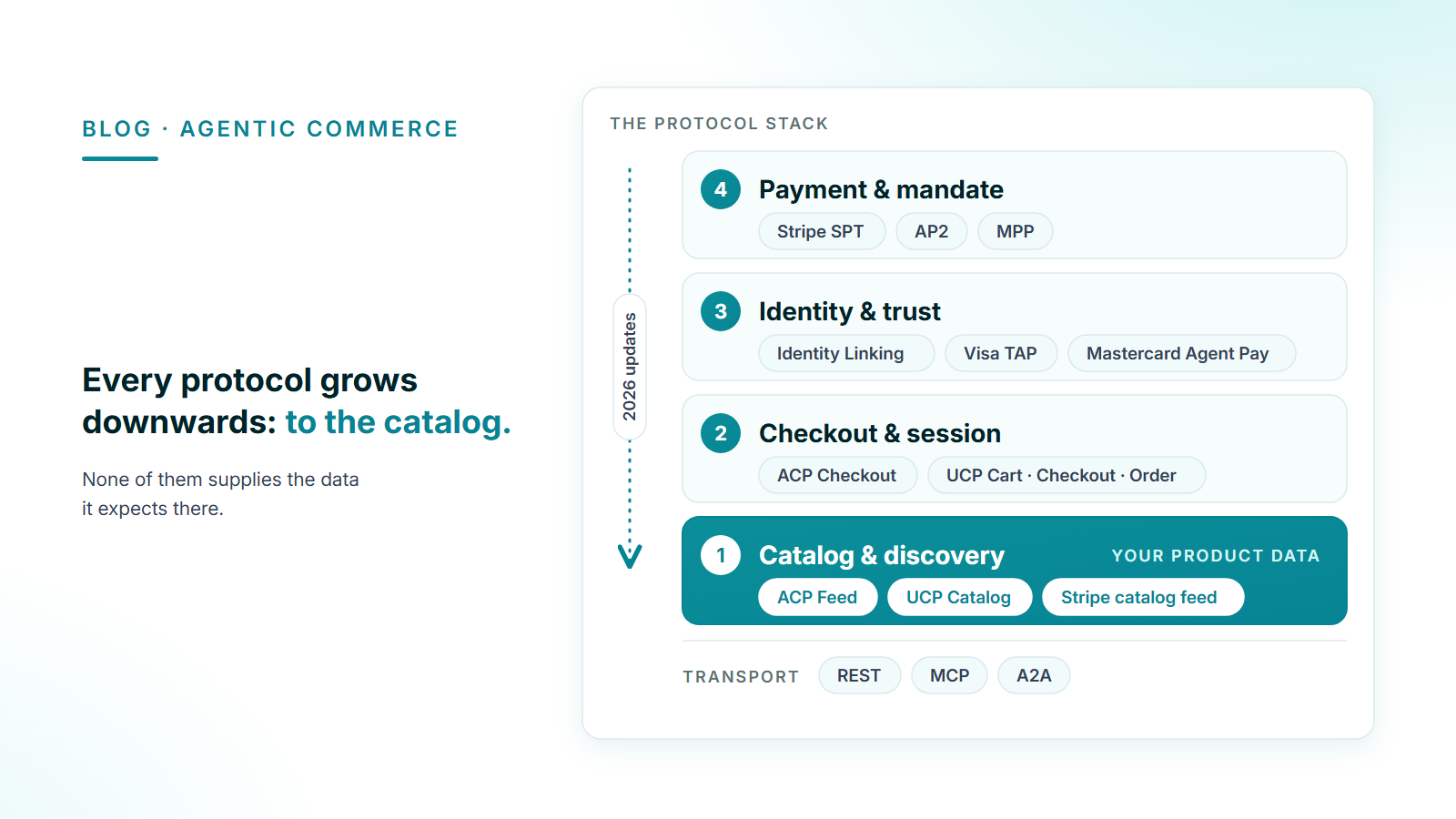
ACP, UCP, AP2 and Stripe together form a stack of four layers. For a year, every protocol has been growing towards the catalog, and that's the one layer none of them handles for you.
A week ago, we described what AI agents check in product data before they recommend anything. Today we go one level deeper, into the technology underneath. Anyone talking about agentic commerce in autumn 2026 mostly hears acronyms: ACP, UCP, AP2, MCP, SPT, TAP, x402. And usually the question of which protocol to bet on.
That's the wrong question. The protocols compete less than it looks. They form a stack of four layers that interlock, and for a year now they have all been growing in the same direction: downwards, towards the catalog.
If you want to understand where agentic commerce is heading, don't ask which protocol wins. Ask which layer none of the protocols will handle for you.
A purchase made by an AI agent consists of four tasks. Each now has its own standards:
Running across all four is the transport layer. Both commerce protocols can be called through classic REST interfaces and now also through the Model Context Protocol (MCP), which AI assistants use to call tools. UCP additionally supports Google's Agent2Agent protocol (A2A).
OpenAI and Stripe introduced the Agentic Commerce Protocol on September 29, 2025, together with buying directly in ChatGPT. It's licensed under Apache 2.0, still officially labeled "beta", and governed by OpenAI and Stripe as founding maintainers. Stripe's documentation now also names Meta as a co-developer.
The version list shows how fast ACP moves. Five releases in seven months:
The current version has five building blocks: agentic checkout (create, update, complete), cart and feed, delegated payment via payment tokens, delegated authentication via OAuth 2.0, and order updates via webhooks.
The order of events is telling. ACP started with checkout. In March 2026, OpenAI scaled back buying directly in the chat: merchants use their own checkout again, and ChatGPT focuses on product discovery. One month later, the feed became its own interface in the spec. The protocol moved from payment to catalog, not the other way round.
Google introduced the Universal Commerce Protocol on January 11, 2026, developed with Shopify, Etsy, Wayfair, Target and Walmart. The project site now also lists Amazon, Microsoft, Meta, Salesforce and Stripe as co-developers, with Visa, Mastercard, Adyen and PayPal among its endorsers. UCP is also licensed under Apache 2.0.
UCP is broader than ACP and organized into capabilities that a merchant can switch on one by one:
Cart, Catalog and Identity Linking arrived with the March 19, 2026 update, alongside simpler onboarding through Google Merchant Center. The largest release so far shipped on August 25, 2026. It adds support for more verticals such as grocery, location search with opening hours, 3DS2 authentication, installments and split payments, a loyalty extension, and several breaking changes that existing integrations need to adapt to. In September, a Payments Technical Council with eight members followed, including Google, Shopify and Stripe.
On October 15, 2026, Google built on this and launched the Universal Cart in the US: a cart in Google Search and the Gemini app that collects products from several retailers, tracks price drops and draws on a Shopping Graph of more than 60 billion product listings. Payment runs through UCP and Google Pay, or the shopper sends the items to the merchant's own cart. Either way, the merchant remains the seller.
Stripe is the only major player sitting in both camps. It co-founded ACP, it's a co-developer of UCP, and it has secured a role that's more practical for merchants than any protocol decision: one integration that serves several agents.
The building blocks at a glance:
For merchants, Stripe takes part of the protocol question off the table. What's interesting is where the integration starts: with a structured catalog feed of product and inventory data.
The fourth layer answers the trickiest question: how does a merchant know an agent is really acting on a customer's behalf?
Google's Agent Payments Protocol (AP2) relies on signed mandates, digitally signed proof of what the customer authorized the agent to do. It was introduced in September 2025 with more than 60 organizations. In April 2026, Google handed AP2 over to the FIDO Alliance, the body behind the passkey standards. Version 0.2 allows payments without the customer present, as long as the agent stays within limits approved in advance. UCP integrates AP2 mandates as an extension.
The card networks are building their own trust layer in parallel. Visa's Trusted Agent Protocol, published with Cloudflare in October 2025, lets merchants recognize agents by cryptographic signatures. Since October 20, 2026, a first live B2B pilot has been running in which an agent pays approved supplier invoices. Mastercard follows the same approach with Agent Pay and opened early access to a machine-to-machine variant in October 2026.
Soberly put, this is where things stand in November 2026:
For retailers and manufacturers in Germany, Austria and Switzerland, that means the checkout, trust and payment layers are still in motion and will arrive with a delay. The catalog layer, on the other hand, is already being read today: by ChatGPT, by Google and by every agent that compares products.
Put the changelogs side by side and a pattern emerges. ACP added the feed as its own interface in April. UCP added the Catalog capability in March and followed up in August: structured snapshots of return, refund and warranty policies, richer media types up to video and 3D models, quantities by weight and measure, pickup locations with opening hours. Stripe moved catalog upload into its Dashboard.
The protocols started at payment and arrived at the product. The reason is simple: an agent that can pay cleanly but doesn't understand the product sells nothing.
Read the current versions of ACP and UCP as a requirements list and what you find at the core is a data model:
Every one of these is an attribute, a value range or a relationship in a product data model. No protocol creates this data. All of them assume it.
This layer is exactly where ainavio, the PIM with AI, does its work. Data onboarding reads supplier data from Excel, PDFs and ERP exports and brings it into one consistent structure. AI agents fill in missing attributes, standardize values and units, translate, and check quality before a record reaches any channel. Channel-ready output delivers the data to shops, marketplaces and feeds. And through the MCP server, AI assistants can work directly with the maintained product data.
How strong the pull from demand already is, we described in "One in five ChatGPT queries is a purchase query". The protocols are the platforms' answer to it. The retailers' answer has to be a catalog that machines can read without asking back.
ACP, UCP, AP2 and Stripe's building blocks aren't competing bets but layers of one shared stack: catalog, checkout, trust, payment. Checkout and payment will keep changing, and they're reaching Europe with a delay. The catalog layer is already being read today, and every new protocol version asks for more structure there. If you invest in complete, unambiguous and current product data now, you're ready for every one of these protocols.

Björn Thomsen is Head of Marketing at ainavio, the agentic PIM/DAM system. His focus is marketing operations & engineering: data, automation and the systems behind marketing, increasingly run by AI agents. He brings deep experience from B2B SaaS, cloud and data center companies as well as Tokyo's startup scene. At ainavio, he works on how e-commerce product data serves both people and machines, from the online shop to AI search.
https://www.linkedin.com/in/bjoern-thomsen/
contact@ainavio.com
+49 (0) 2842 - 929987-3

