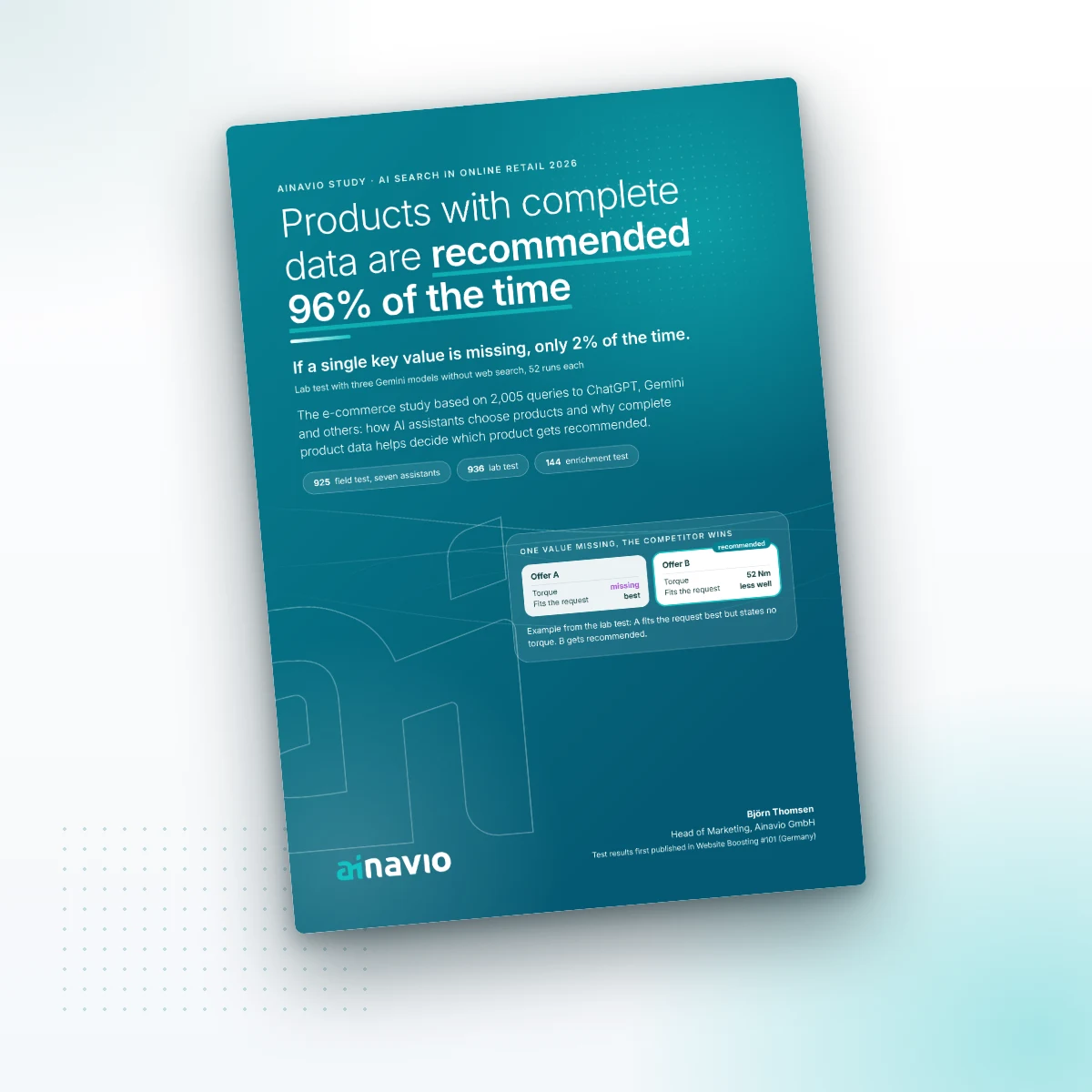
Format? Study, 20 pages as PDF
Basis? 2,005 queries in three tests, October 2026
Author? Björn Thomsen, Head of Marketing at ainavio
Including:
In Germany, nobody buys inside the chat yet, but the choice is already made there. 31% of German online shoppers have already asked a chatbot for product recommendations (bevh, 2026). Which product gets named is decided by product data, not by marketing copy.
In the field test, the assistants based their recommendations on data values, a median of 7 to 12.5 per answer. If a value is missing, your product is missing an argument.
OpenAI, Google, Microsoft and Perplexity say openly what helps: product feeds and complete, structured product details.
Merchant programs exist mainly in the US so far. In Germany, most assistants read your product pages, price comparison sites and marketplaces.
Six results that matter most for retailers and manufacturers. All figures, charts and the methodology are in the study.
All values complete: how often the best-fitting product was recommended.
One key value missing: how often it was still recommended.
of ChatGPT product cards for German shopping questions were in a foreign language
queries to ChatGPT, Gemini and others evaluated
96% and 2%: lab test with three Gemini models without web search, 52 runs each.
With complete data, three Gemini models without web search recommended the best-fitting product in 96% of runs. With a single key value missing, only in 2%. A weaker competing product with complete data almost always won instead.
When feed and product page stated different values, the best-fitting product was recommended in only 6% of runs. When a value appeared only in body text or its unit was missing, it was recommended in only 71% and 69% of runs.
For German shopping questions, ChatGPT showed 463 product cards. 232 of them (50%) were in a foreign language, mostly English, but also Dutch or French.
In 115 of 174 queries about timing, the assistants claimed a product was available, and 58% of these claims came without a specific retailer statement.
In 54% of answers with evaluable links, at least one price comparison site, review portal or media outlet was cited. Most-cited domain: idealo, ahead of Amazon. Your product data therefore has to be right there as well.
When enriching data from supplier data sheets, the language model with an everyday prompt filled 24% of inferable gaps with a guessed value. With three simple checking rules: 0%. The prompt to rebuild is included in the study.
The study is aimed at everyone who decides how products are described and distributed online:
20 pages with many charts and little text, methodology and sources in the appendix.
“If a single key value is missing, the best-fitting product is recommended only 2 percent of the time instead of 96 percent. Product data is no longer a maintenance task, it is a sales argument.”
– Björn Thomsen, Head of Marketing at ainavio
Björn Thomsen is Head of Marketing at ainavio and the author of the study. His focus areas are marketing operations, agentic AI and performance marketing. He is driven by how product data can be readable for people and machines at the same time. The test results first appear as the cover story of the German trade magazine Website Boosting #101.