PIM is dead? Quite the opposite. Why PIM is becoming the active center of the agentic product data process – and what that means for SEO, GEO, and Agentic Commerce.
PIM, DAM, MDM, or PXM? Maybe we're asking the wrong question.
Anyone who works with product data knows the drill: four acronyms, four systems, four slide decks. And at some point someone says, “What we really need is a single source of truth.” Everyone nods. No one asks what happens next.
Because product data today isn't just something you manage anymore. It has to be understood from wildly different sources, enriched, researched, prepared for search engines and AI systems, and pushed out to an ever-growing number of channels. So the question isn't “Do we still need a PIM?” It's: What does a PIM actually need to do so raw data becomes sellable, high-quality product information that both people and machines can understand?
PIM was built for a world where product data was mainly a management problem: information scattered across ERPs, spreadsheets, PDFs, and suppliers, and PIM was there to centralize it. That was the right idea – just too passive. A classic PIM waits for someone to feed it data.
A new supplier rarely sends a perfectly structured file. Usually it's a spreadsheet, a PDF, or both – half the information in a data sheet, the rest scattered somewhere on the manufacturer's website. Before that becomes a sellable product, the data has to be imported, understood, classified, completed, and pulled together through images, copy, and translations.
That's exactly the flaw in the classic picture: PIM as a mere storage place, with research, enrichment, and content creation happening around it as separate tasks. Thought through properly, it's the other way around.
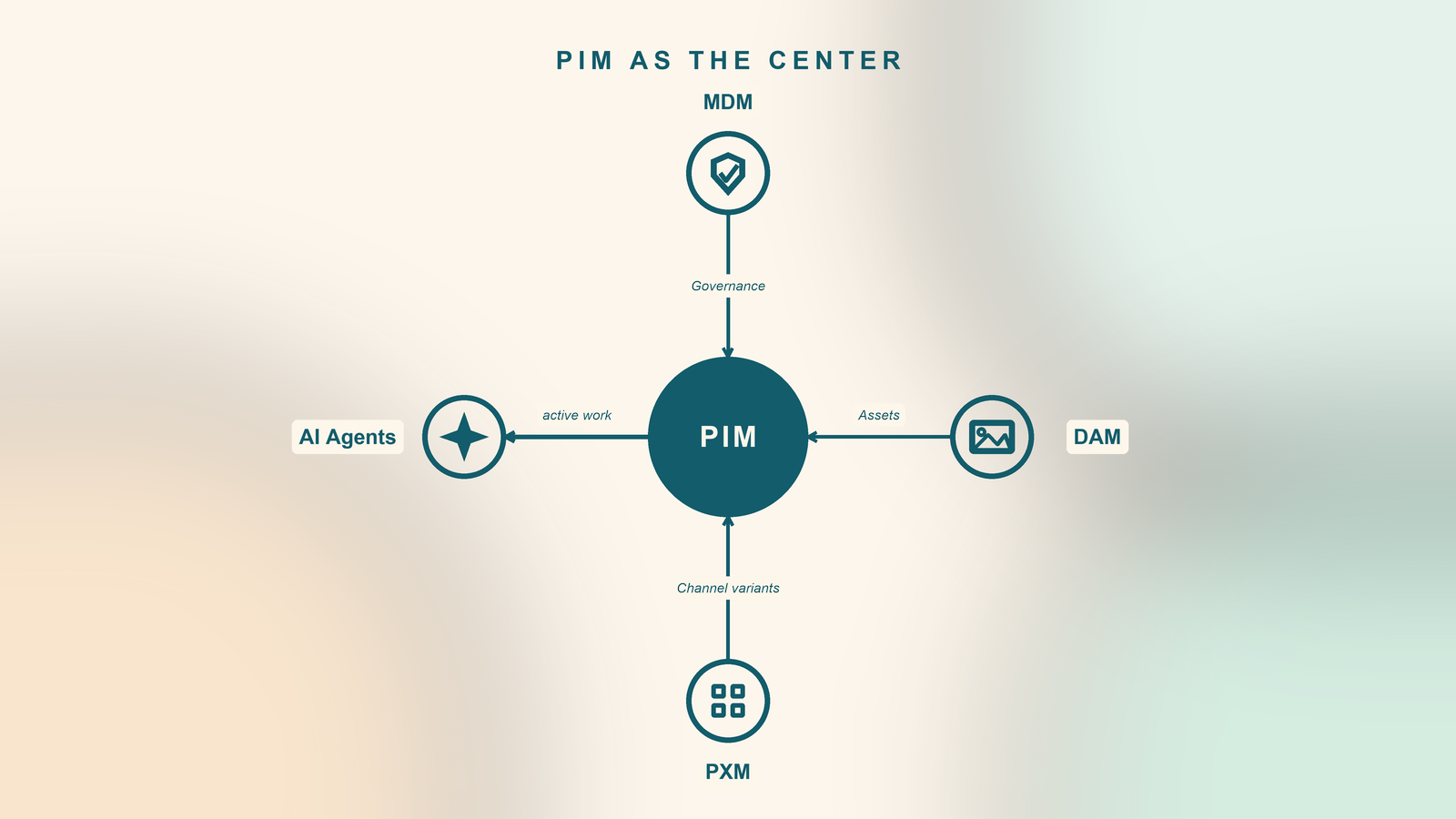
MDM governs master data. DAM manages assets. PXM controls channel-specific presentation. All three matter – but none of them, on its own, can turn raw data into a sellable, machine-readable product.
That's exactly why PIM becomes the hub where these perspectives converge. Not as another system alongside the others, but as the place where provenance (MDM), assets (DAM), and channel variants (PXM) come together for every product and get actively worked on by AI. The question isn't which of the four systems you need anymore. It's: how well can PIM, as the center, coordinate work that used to be spread across four tools?
A classic PIM waits for humans to maintain product data. An agentic PIM works on it actively – as the center from which the work is coordinated, not alongside it.
10,000 new products, data coming from ERP, supplier PDFs, spreadsheets, and product photos. One supplier writes “weight,” the next “item weight,” a third “net weight.” “Stainless steel,” “Edelstahl,” “SS” all mean the same material. A person can clean that up – or PIM itself can take it on: ingesting sources, classifying products, extracting attributes, normalizing terminology, flagging gaps. A technical PDF becomes a structured record, right inside the central system. A storage place becomes a workbench.
Three developments are converging on the same point: without good product data, AI produces bad results – and without a center that actively maintains that data, it stays bad.
SEO: AI can write ten thousand product descriptions in seconds. The problem isn't volume anymore – it's quality, and quality depends directly on the product data it's generated from.
GEO: Users increasingly ask AI systems instead of search engines – “Which drill can handle concrete and has at least 18 volts?” To answer that, an AI needs clear, structured attributes from exactly one reliable source.
Agentic Commerce: Increasingly, AI agents search and compare on their own, before a human ever sees a product page. Poor product data isn't just an SEO problem here – it's a commerce problem. What an agent can't understand, it can't recommend.
This gets especially powerful when AI doesn't just rephrase existing information but actively researches what's missing – and writes the results straight back into the central record. A Research Agent spots gaps, searches relevant sources, and feeds the results back into PIM. Raw data goes in, PIM understands it, gaps get identified and researched, the data gets better, and better, channel-ready content comes out – all in one place. Not a separate process alongside PIM. PIM is the process.
This is exactly where ainavio comes in: not as a data warehouse next to other tools, but as an agentic workspace in which PIM itself becomes the center. The Research Agent ingests ERP data, PDFs, spreadsheets, and other sources and fills in missing information. The Classification Agent and Enrichment Agent categorize products and complete attributes, titles, and descriptions. The Mapping Agent automatically transforms them to fit the requirements of shops and marketplaces, and the Translation Agent localizes them for new markets. The Quality Agent watches over the completeness and consistency of the central Golden Record, and the Publishing Agent only publishes once a product is channel-ready.
The end result isn't a fully maintained record sitting somewhere – it's a product that's ready for commerce, straight from the center. For your own shop, for marketplaces, for new markets, and increasingly for a world where AI systems search for and recommend products themselves.
Don't ask: how well can this system store product data? Ask: how much is it the active center that everything else organizes around? How well does it spot missing information and fill it in automatically? How much manual work is still left between the supplier's PDF and the finished product page? And above all: how much of this process can your PIM take on itself?
Structured product data and a central data foundation remain essential – more than ever. But the idea of PIM as a passive storage place, with research, enrichment, and content creation happening around it, belongs to the past. Those tasks belong inside PIM, not next to it.
Not PIM vs. DAM vs. MDM vs. PXM. But: PIM as the center that AI understands – and increasingly runs itself.
Maybe that's the better definition of a modern PIM: not a place where product data sits. An engine that turns product data into commerce.

Björn Thomsen is Head of Marketing at ainavio, specializing in B2B SaaS, demand generation, marketing automation, and leveraging AI to scale modern marketing processes.
https://www.linkedin.com/in/bjoern-thomsen/
contact@ainavio.com
+49 (0) 2842 - 929987-3