Mirakl technically connects Bauhaus, OBI, Galeria and MediaMarkt/Saturn — but not their attribute models. Why commerce velocity stays an illusion without automated mapping, and every new marketplace exposes it again.
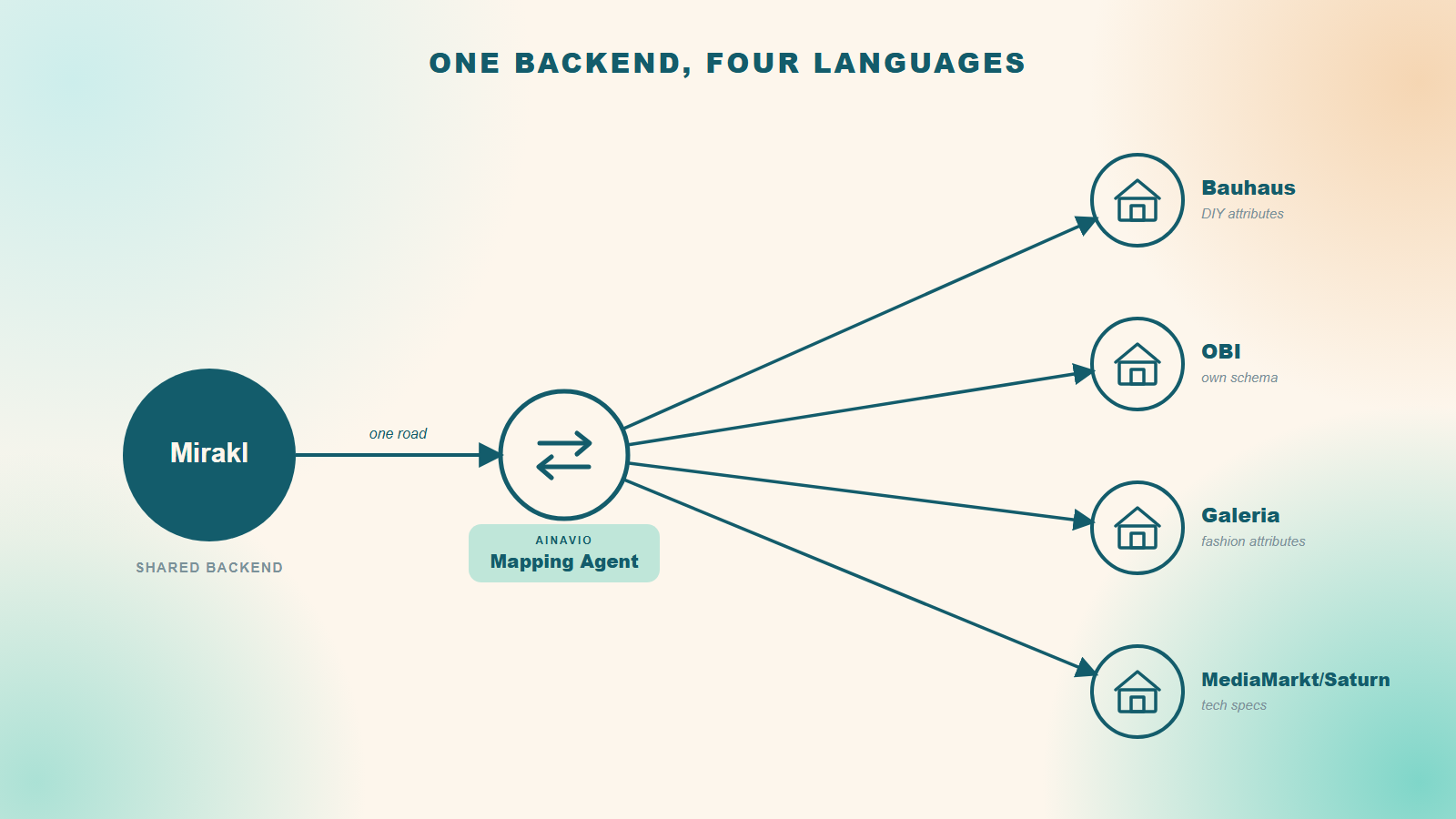
All roads lead to Rome — that was always a matter of infrastructure, not language. Whoever arrived still had to read what applied locally: different names, different units, different rules. The road was shared. The map wasn't.
In e-commerce, that road is often called Mirakl. Bauhaus, OBI, Galeria, MediaMarkt/Saturn, Fressnapf, Hornbach, Decathlon, home24 — a good dozen of Germany's best-known marketplaces run technically on the same platform. Know that, and it's tempting to draw the wrong conclusion: one connection, many channels, scale almost for free.
That's the promise behind what got celebrated recently as Commerce Velocity: speed as the new currency, measured by how fast a catalog reaches new sales channels. But that picture is, at best, half the story.
A shared backend is not a shared language.
And that's exactly where retailers keep walking into the same trap, without noticing it at the start of the next marketplace.
Mirakl is the technical platform behind many of the marketplaces above — not a marketplace itself, but the infrastructure Bauhaus, OBI, Galeria or MediaMarkt/Saturn each run their own marketplace model on. That's a genuine efficiency gain: you don't have to build a completely new technical connection for every one of these marketplaces.
What Mirakl doesn't standardize is the attribute model behind it. Every operator defines its own required fields, its own category trees, its own names for practically identical properties. A cordless drill's voltage is called "voltage" on one marketplace, "rated voltage" on the next, and buried in a free-text field called "technical specs" on the third. The backend is shared. The taxonomy isn't.
For a retailer, that means every new Mirakl marketplace looks on paper like a small technical exercise — credentials, a catalog feed, done. In practice, the same work that already happened for the first marketplace starts over: mapping attributes by hand, interpreting free text, documenting exceptions.
Call this recurring problem the mapping tax: the effort that comes due again with every new channel, regardless of how much technical infrastructure is already shared. It never shows up on a roadmap, because it isn't a project — it's an overhead line item that repeats every time someone decides to "quickly connect one more marketplace."
The real issue with the mapping tax isn't its size in any single case — it's that planning never sees it. Whoever quotes "time to market" for a new channel is usually counting the contract signature, the technical integration, and the first test upload. The weeks a product-data team needs to squeeze 8,000 SKUs into a new attribute schema rarely show up in that math — that work happens "on the side," parallel to daily business, mostly by hand in a spreadsheet.
A hardware-store catalog with 12,000 active products, listed in parallel on OBI, Bauhaus, Hornbach and Amazon, technically runs across two backends: Mirakl for the first three, a separate connection for Amazon. Four marketplaces, four attribute logics — despite the shared infrastructure behind three of them.
Add a fifth marketplace — say Hagebau, or a new Mirakl partner — and that math doesn't change. A product-data team already working at capacity doesn't get a "quick extension." It gets another rulebook that has to be mapped against the same 12,000 products, attribute by attribute, category by category. That's exactly the moment "speed to market" tips into delay: the new channel goes live later than planned, or it goes live with incomplete data — which usually means worse visibility and more back-and-forth with the marketplace.
Here's the actual punchline: a retailer can simulate commerce velocity in the short term without solving the underlying mapping problem. A new marketplace can be technically connected, a first catalog uploaded, a press release written — "now live on X, too." On paper, that counts as speed.
What that snapshot doesn't show: how many of the listed products are actually complete, correctly attributed, and therefore findable. A catalog that launches on a new marketplace with half-finished attributes hasn't gained velocity — it's just pushed the mapping tax into the future, where it resurfaces as complaints, deranking, or manual rework under time pressure. Velocity built on a manual mapping backlog is borrowed time, not earned time.
The metric that actually matters, then, isn't how fast a marketplace gets technically connected — it's how fast a complete, channel-compliant catalog goes live on it. That's a mapping problem, not a connection problem, and mapping problems don't get solved permanently with more manual hours. They get solved with fewer.
This is exactly where ainavio, as an agentic workspace for product data, comes in. Instead of matching every new marketplace against your own attribute model by hand again, the Mapping Agent automatically transfers categories and attributes to each target system — no team has to maintain mapping rules manually.
That works because ainavio doesn't manage product data per channel, but centrally, in the PIM: one golden record per product, from which every connected channel — a Mirakl marketplace like Bauhaus or OBI, or an independent connection like Amazon or Shopify — is automatically supplied with the attributes, labels and required fields it specifically needs. Before every export, the system checks completeness, consistency and channel compliance, so incomplete data never goes live in the first place.
The effect shows up in the metric that actually matters, not in the number of connected channels: customers who automate their product-data onboarding this way report up to ten times faster onboarding for new catalogs. The twelfth marketplace no longer costs more effort than the first — because the translation work no longer sits with people. It sits with the agent.
All roads still lead to Rome, and a shared backend like Mirakl remains a genuine advantage — just not a substitute for the translation work that comes due again at every destination. The difference between a retailer who starts from zero at every new marketplace and one who simply flips on the next channel isn't the number of roads. It's who reads the map — a team that translates from scratch each time, or an agent that already knows how.
Commerce velocity isn't a promise of infrastructure. It's the result of what happens to your data before it ever reaches the road.
A shared Mirakl backend technically connects Bauhaus, OBI, Galeria, MediaMarkt/Saturn and a dozen other marketplaces — but it doesn't unify their attribute models. Every new channel reactivates the same manual mapping work that "speed to market" was supposed to eliminate, as long as that one step stays manual. Commerce velocity can be faked on the surface, but it can't be forced: it only exists once the mapping itself is automated — not just the connection.

Björn Thomsen is Head of Marketing at ainavio, specializing in B2B SaaS, demand generation, marketing automation, and leveraging AI to scale modern marketing processes.
https://www.linkedin.com/in/bjoern-thomsen/
contact@ainavio.com
+49 (0) 2842 - 929987-3