Black Friday is won by whoever has their product data under control in October, not by whoever offers the deepest discounts in November. A look at the four data bottlenecks that cost revenue during peak season.
"Hope is not a strategy."
— Saying from operations management
Every autumn the same ritual begins: campaign plans, discount tiers, ad budgets, load tests. Retailers prepare for the rush as if Black Friday were a marketing event.
It is, above all, a data event.
During peak season it is not just offers that compete, but product pages, feeds and marketplace listings. And those are not built in November. They are built now.
The question is not how much traffic your campaign will bring, but how many products are ready to receive it.
In normal weeks, incomplete product data barely registers. A missing attribute costs a conversion here, a weak description there. At peak, the same gaps become a multiplier: more visitors hit the same unfinished pages, and the number of lost purchases grows with them.
On top of that, shoppers buy faster and compare harder at peak. Choosing between three similar offers, they pick the one that answers their questions before they ask them: dimensions, compatibility, scope of delivery, material.
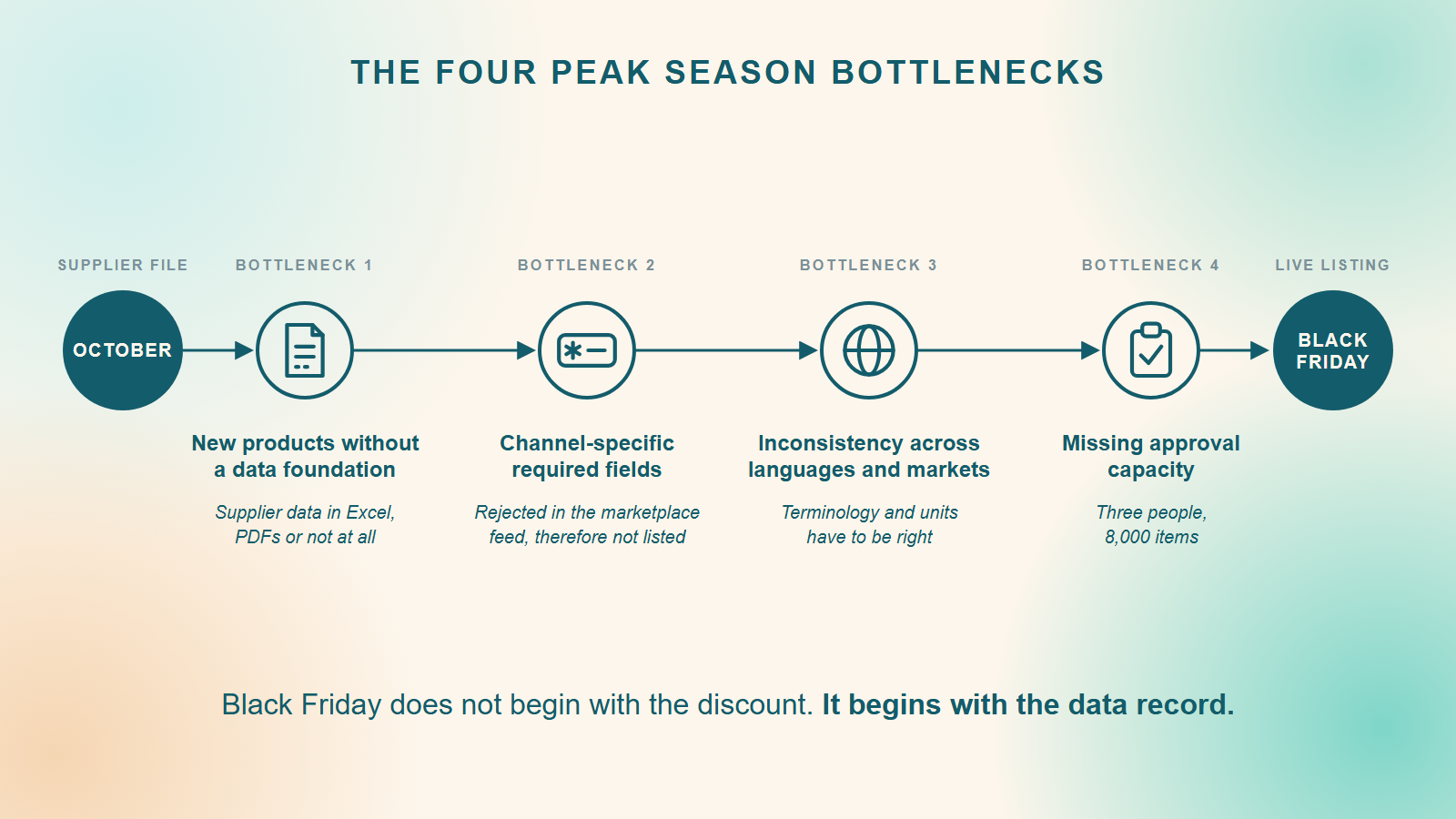
In practice, peak readiness rarely fails because of a single thing. Usually it is four recurring bottlenecks, which we call the peak season bottlenecks:
1. New products without a data foundation. Seasonal items, gift sets and promotional products often arrive late, with supplier data in Excel, in PDFs or not at all. Onboarding becomes the bottleneck.
2. Channel-specific required fields. Every marketplace and every shop demands its own categories, attributes and formats. A product that looks clean in your own shop gets rejected in the marketplace feed and is therefore not listed.
And an unlisted product has a conversion rate of zero, no matter how good the campaign is.
3. Inconsistency across languages and markets. Selling across borders at peak requires translations that get terminology and units right. A manual translation pass shortly before the deadline is rarely thorough.
4. Missing approval capacity. Even when the data exists, it has to be reviewed and approved. If three people are to check 8,000 items, the deadline passes faster than the work gets done.
Imagine a household goods retailer. For peak season, 6,000 new and revised items enter the range. Supplier data varies in quality: some records lack dimensions, others say "stainless steel" in the title but nowhere in the material attribute. Three marketplaces each require a different category structure.
The classic route: reconcile spreadsheets, research gaps by hand, write copy, assign categories, collect approvals. The team works overtime, and products still go live only after the start. The retailer then misses half of the very days that bring the most revenue.
The difference is not more effort, but a different process.
This is where ainavio comes in as an agentic workspace. Instead of treating product data as a sequence of manual single steps, AI agents take over whole blocks of work along the product data lifecycle:
The Research Agent finds missing manufacturer and product information. The Enrichment Agent adds attributes, titles and descriptions. The Classification Agent assigns categories, and the Mapping Agent maps them to the requirements of target systems. The Quality Agent flags gaps and inconsistencies before a marketplace rejects them, and the Publishing Agent validates against channel requirements and publishes.
The team no longer approves every record, but reviews exceptions. Approval capacity scales not with the number of items, but with the number of genuine problem cases.
Peak readiness cannot be built in a day, but it can be measured now. Three questions are enough to start:
How many items are channel-ready today? Not "filled in", but accepted by every target channel.
How long does it take from supplier file to live listing? If the answer is weeks rather than days, that is your bottleneck.
Where do errors recur? The five most frequent marketplace rejection reasons are usually a process problem, not an isolated case.
Back to the sentence at the start: hope is not a strategy. Anyone who hopes the data will somehow be ready by the deadline has already left the outcome to chance.
Black Friday does not begin with the discount. It begins with the data record.
Conclusion: Peak season is decided less by advertising budget than by the product data process. Those who onboard new products quickly, prepare data for each channel and check quality automatically enter the rush with more listed, complete products. An agentic PIM provides the speed and capacity for this before things get tight.

Björn Thomsen is Head of Marketing at ainavio, specializing in B2B SaaS, demand generation, marketing automation, and leveraging AI to scale modern marketing processes.
https://www.linkedin.com/in/bjoern-thomsen/
contact@ainavio.com
+49 (0) 2842 - 929987-3